Dual-Lane Latency Architecture in Ternary Logic (TL)
A hardware-enforceable execution model designed for high-integrity, low-latency environments such as financial trading infrastructure, featuring two physically distinct but synchronized lanes: a Inference Lane for provisional execution and an Governance Lane for verification, cryptographic anchoring, and finality enforcement.
Inference Lane
Provisional execution with response time less than <2 ms
Governance Lane
Verification and finality enforcement with response time of 300–500 ms
Key Principle: No irreversible commit occurs without Governance Lane convergence, ensuring provable integrity in cryptographic anchoring.
Architecture Overview
Ternary Logic States
The system uses ternary states to represent execution decisions:
- +1 Commit: Final approval for irreversible execution
- 0 Null: Neutral state or pending decision
- -1 Reject: Rejection of execution request

Critical Requirement: The latency of exchanges in Market Making is inevitable due to hardware limitations, system processing times, and delays in receiving data, making dual-lane architecture essential for maintaining system integrity while meeting performance demands.
High-Frequency Execution
Optimized for high-frequency trading strategies requiring low-latency, high-throughput processing capabilities.
Cryptographic Anchoring
Buffered cryptographic anchoring pipelines ensure secure and verifiable transaction finality.
Adversarial Resilience
Designed to withstand adversarial attacks while maintaining mathematical stability under burst traffic conditions.
Hardware Realization
Formal Verification and Assertion-Based Validation
SystemVerilog Assertions (SVA)
This paper documents valuable SystemVerilog Assertion tricks, including use of long SVA labels, use of the immediate assert command, and concise SVA coding styles, which are essential for verifying the correctness of the dual-lane architecture's behavior.
This simulation step ensures that assertions involving asynchronous resets are adequately covered, thereby complementing the formal verification process required for the dual-lane system's safety-critical operation.
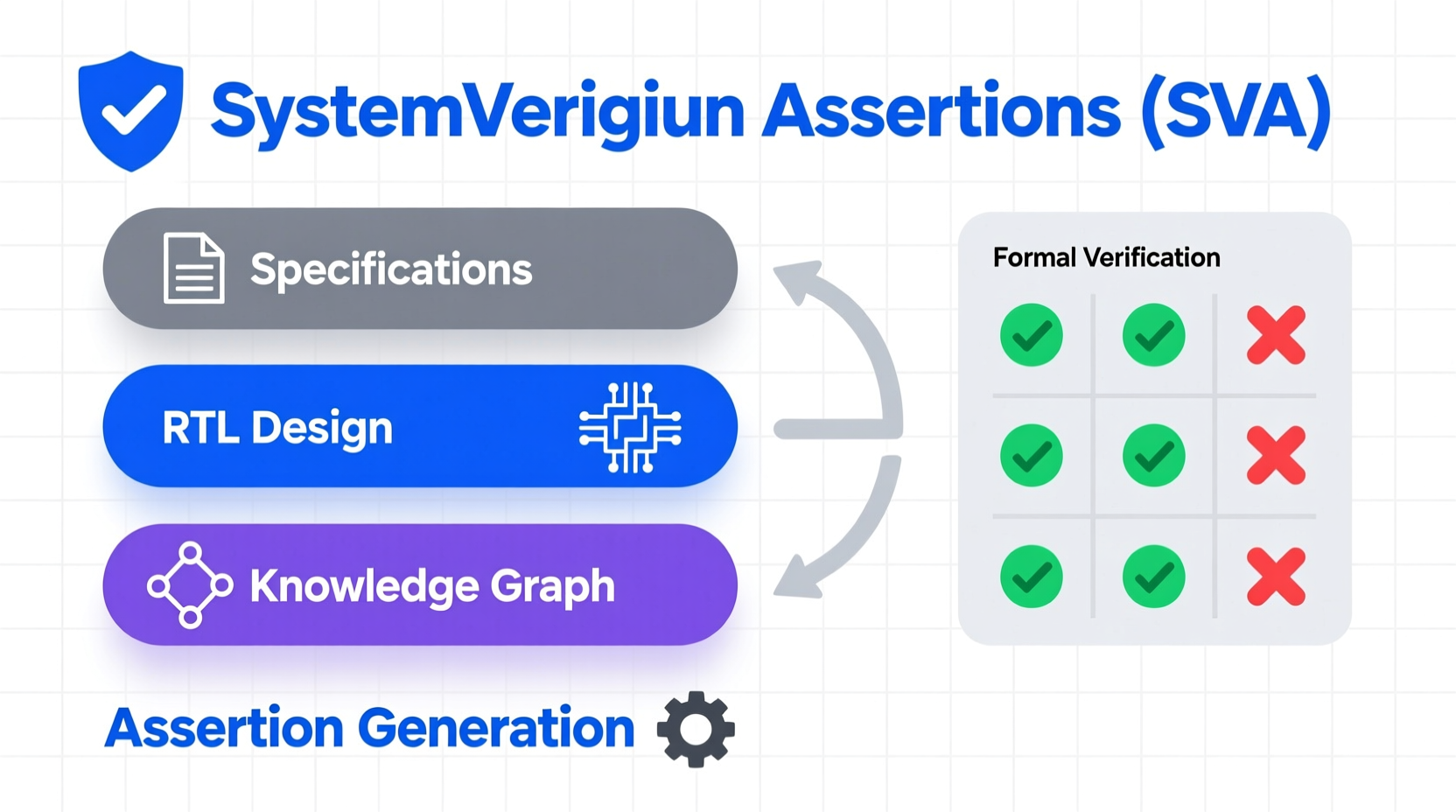
Knowledge Graph Approach: Constructing a Knowledge Graph from both specifications and RTL using a hardware-specific schema with domain-specific entities enables systematic assertion generation for complex dual-lane interactions.
Linear Temporal Logic (LTL)
LTL properties ensure that critical safety requirements such as mutual exclusion between fast and governance lane states are maintained throughout system execution.
Property Checking
SVA property checking verifies that the ternary logic states transition correctly and that no irreversible commit occurs without governance lane convergence.
Verification Challenges
SVA: in Async logic? Ideas exist for using SVA in async, unlocked logic, addressing the challenge of verifying asynchronous components within the dual-lane architecture.
Complex hardware systems become more and more ubiquitous in mission critical applications such as military, satellite, and medical, requiring bounded model checking for asynchronous concurrent systems to ensure reliability.
Queueing Theory Analysis with Burst Traffic Models
The latency of the exchanges in Market Making (MM) is inevitable due to hardware limitations, system processing times, delays in receiving data, creating complex queueing dynamics that must be analyzed using appropriate mathematical models.
Transactions queue, confirmations lag, and settlement windows stretch across time intervals, demonstrating the need for robust queueing theory analysis to understand system behavior under varying load conditions.
Statistical Optimization: A statistical methodology has been developed to optimally design a pipeline circuit for enhancing yield, with optimization results showing that proper imbalance among stages improves performance metrics.
Heavy-Tailed Traffic Models
Heavy-tailed distributions capture the bursty nature of financial transactions and trading activities, where occasional large spikes in traffic can significantly impact system performance.
High CPU utilization can cause extended latency to your user because the infrastructure cannot perform tasks in a timely manner, emphasizing the importance of understanding traffic patterns.
Softer tradeoff between both power and area versus performance than reducing the decoder wordlength, retaining almost all of the power savings, indicating the need for careful resource allocation under burst conditions.
Markov-Modulated Poisson Process (MMPP)
MMPP models capture the switching behavior between different traffic regimes, reflecting the alternating periods of high and low activity typical in financial markets.
Either asynchronous or synchronous systems may exhibit latency, and in synchronous cases, a sampling delay must be provided, affecting queueing behavior analysis.
The HFT stack represents the complete architectural framework—from physical servers and network infrastructure to sophisticated trading algorithms—requiring queueing analysis across all layers.
Security Risk: Remote Code Execution (RCE) risk exists when developers load models, bypassing supply chain security frameworks, potentially introducing malicious traffic patterns that disrupt normal queueing behavior.
Adversarial Threat Modeling and Resilience
Denial of Service
Burst traffic patterns can overwhelm the inference lane, causing delays in governance lane convergence and compromising system availability.
Timing Attacks
Attackers may exploit timing differences between inference and governance lanes to infer sensitive information about transaction processing.
Logic Flaws
Improper handling of ternary logic states or race conditions between lanes could lead to inconsistent transaction outcomes.
Implementation Considerations and Trade-offs
Energy-Latency-Area Trade-offs
RTL Implementation Strategy
This standard provides a set of extensions to the IEEE 1364™ Verilog® hardware description language (HDL) to aid in the creation of vendor-agnostic but physically enforceable RTL code suitable for the dual-lane architecture.
Official IEEE 1800-2023 SystemVerilog standard includes support for modeling hardware at behavioral, register transfer level (RTL), and gate-level abstraction levels, providing the foundation for dual-lane RTL implementation.
3D Integration and Advanced Packaging
Use of 2.5D/3D integration to connect discrete CMOS logic dies to the internal pins/TSVs of a memory, enabling high-density integration of fast and governance lane components on separate dies.
Monolithic Hybrid-3D Standard Cell Library with Sandwiched Inter-Metal Layer for 3D Digital Computation-in-Memory Circuits provides the architectural foundation for implementing the dual-lane system with minimized interconnect delays.
Highly area-efficient low-power SRAM cell with 2 transistors and 2 resistors, and WSe2/MoS2 CFET based half-adder circuit using monolithic 3D integration demonstrates the feasibility of ultra-compact ternary logic implementations.
Thermal Management: Efficient 3D representations of 3D chip floorplans enable thermal-aware physical design, crucial for managing heat dissipation in high-performance dual-lane implementations.
Vendor-Agnostic Design Principles
- Standard HDL constructs compatible with multiple synthesis tools
- Modular architecture enabling component reuse across platforms
- Abstract timing constraints independent of specific process nodes
Near-Future Process Node Assumptions
- Targeting 2nm and below process nodes for optimal performance
- Leveraging strained GAA FETs for enhanced speed and power efficiency
- Utilizing advanced materials like Mo for sub-2nm interconnect optimization
Conclusion
The Dual-Lane Latency Architecture in Ternary Logic (TL) represents a significant advancement in high-integrity, low-latency computing systems, particularly suited for financial trading infrastructure and other safety-critical applications requiring provable transaction finality.
Key Contributions
- Hardware-enforceable execution control using ternary logic states
- Asynchronous logic design leveraging NULL Convention Logic (NCL)
- Comprehensive formal verification using SystemVerilog Assertions
- Rigorous queueing theory analysis for burst traffic resilience
- Adversarial threat modeling with mathematical stability guarantees
Implementation Feasibility
- FPGA prototyping pathway using established NCL libraries
- ASIC implementation targeting 2nm and below process nodes
- 3D integration for minimizing interconnect delays
- Vendor-agnostic RTL design principles
Future Vision: Imagine an intelligent real-time world where waits and delays, queues and paperwork, hassles and drudgery dissolve in almost instantaneous provision of goods and services, enabled by architectures like the dual-lane system described here.
This research establishes a technically rigorous foundation for implementing dual-lane latency architectures that balance throughput efficiency with provable integrity in cryptographic anchoring, providing a workload-agnostic framework applicable across diverse high-frequency computing domains.